Planning · 4 min read
Before you build: permits, property lines and calling 811
Published 5 September 2026
The three things worth settling before a post hole is dug: where your line actually is, what your town and HOA require, and the free call that stops you hitting a gas line.
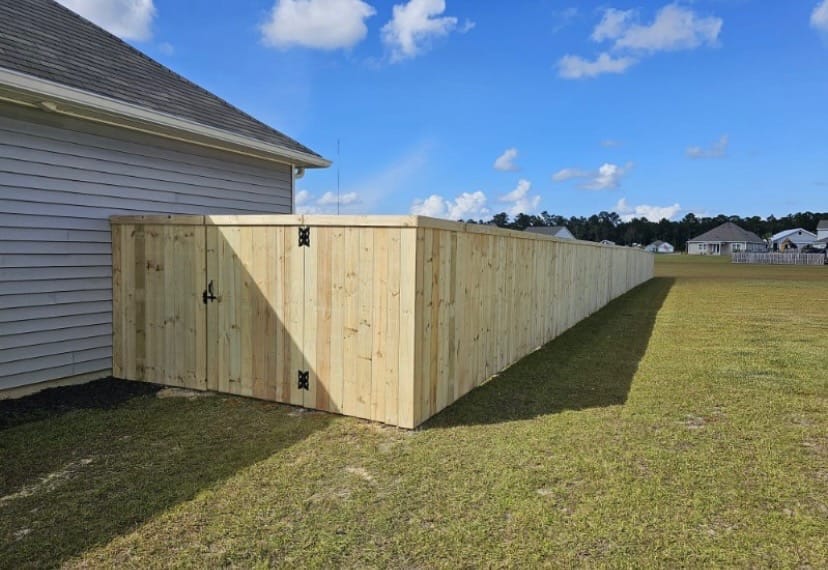
Most of the fence problems we are called about afterwards are not building problems. They are boundary problems, permit problems, and one very avoidable kind of problem involving a buried line.
Call 811. It is free, and it is the law
Before anybody digs in South Carolina, the utilities have to be located and marked. You do this by contacting SC811 — by phone on 811 or online — and it costs nothing.
They notify the utility companies, who come out and mark what is buried where with spray paint and flags. It takes a few working days, which is why it is the first thing to start rather than the last.
Skipping it is not a paperwork risk. It is a gas line risk. If we are building the fence we handle the locate, but if you are digging anything yourself, make the call.
Know where your line actually is
A fence built over a boundary is a legal problem that gets more expensive the longer it stands, and neighbours who were relaxed about it at the time move house.
The reliable answer is a survey. If you have one from when you bought the property, find it. If you do not, and the line is not obvious and agreed, a surveyor is cheaper than moving a fence.
What is not reliable: an old fence line, a hedge, a mowing pattern, or where everybody has always assumed it is. All four are frequently wrong.
Permits and the HOA are two separate questions
Towns in the Charleston area generally require a permit for a fence, and they have rules about height — often different limits front and back — and sometimes about how far back from the property line it has to sit.
Those rules vary by municipality and they change, so we are not going to print numbers here that might be wrong by the time you read them. Check with the town your property is actually in. Mount Pleasant, Charleston, Summerville, Moncks Corner and Awendaw do not all say the same thing.
If you are in an HOA, that is a second and completely separate approval. HOAs commonly have views about material, colour, height and which way the finished side faces, and an HOA approval is not a permit — you may well need both.
Which side faces out
Convention in most of the lowcountry is that the finished side — the side without the rails showing — faces your neighbour and the street. Some HOAs require it. It is worth deciding deliberately rather than discovering it after the fact.
What we handle
We file the municipal permit and arrange the locate as part of the job. What we cannot do is tell you where your boundary is, or get your HOA to agree to something. Those two are worth starting before you book anybody, because they are the ones that hold a job up.